
Rent Control Supporters Pack Hearing Room, Experts Testify at Hearing on Ballot Initiative to Limit Annual Rent Increases
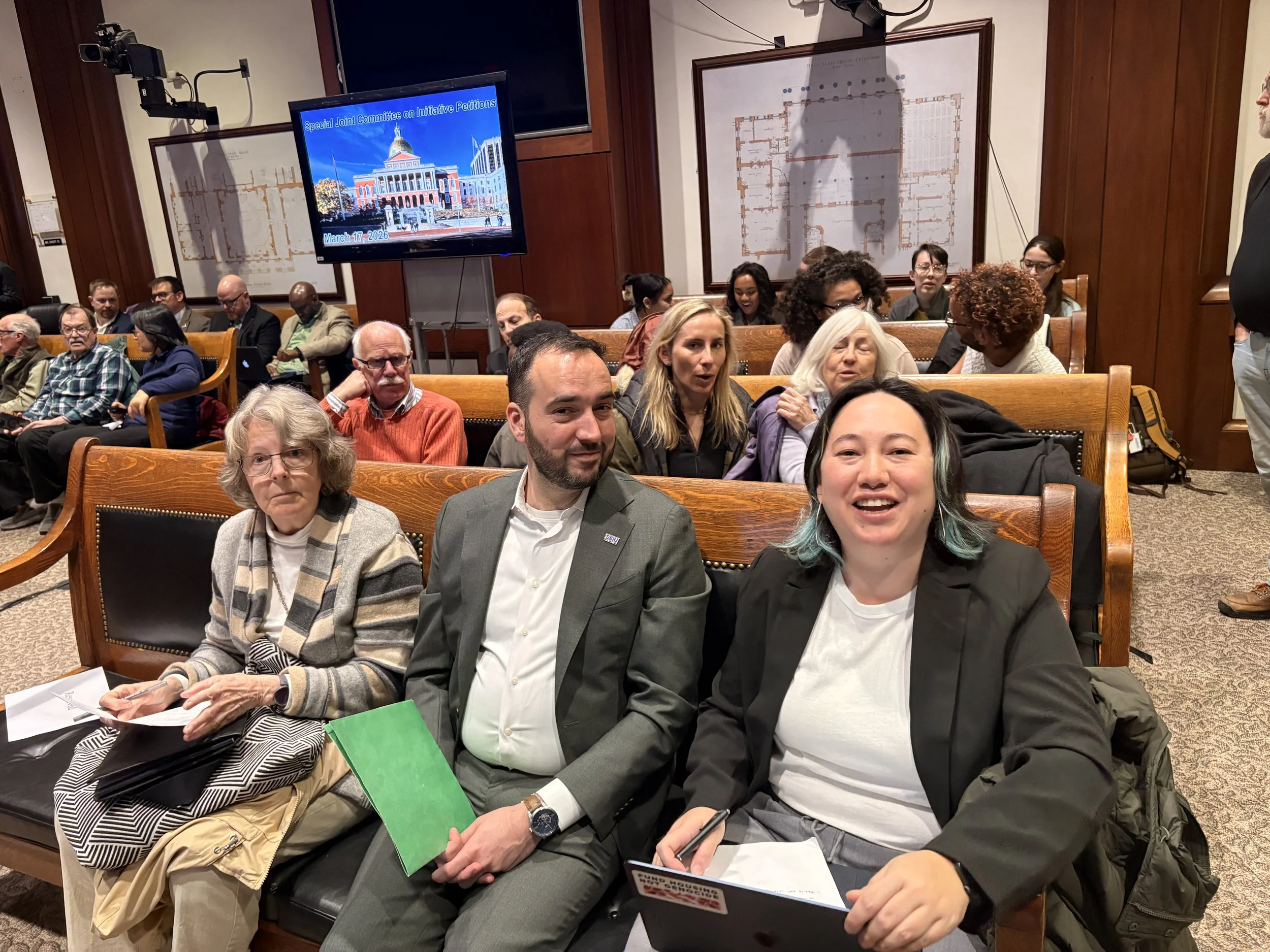
BOSTON — Supporters of the proposed ballot initiative that would limit annual rent increases to no more than 5% packed a hearing room on Beacon Hill today during a legislative hearing on the initiative.
At the hearing of the Legislature’s Special Joint Committee on Initiative Petitions, a panel of local labor and community advocates, national housing policy experts, and local renters spoke about how the ballot initiative would stabilize rents in Massachusetts, protecting tenants from the most egregious rent increases while supporting continued new housing development.
“Whether we rent or own, the places we live are more than just units that are bought and sold – they are the places we come home after a long day, the place we raise families, grow old and age in place. Rent stabilization is a common sense policy to stabilize residents across the Commonwealth, so they can live without the stress of a huge rent increase looming over the places they call home,” said Carolyn Chou, a Dorchester renter and Executive Director of Homes for All Massachusetts. “We all know housing is a crisis in our state, and we need to do everything we can to address it, including building more housing, funding affordable housing programs, and addressing runaway rent increases. This policy is about preventing the rent gouging that’s driving displacement and driving people out of the state. It’s about creating stability for residents, protecting communities from displacement, and ensuring that Massachusetts remains a place where working families can afford to live.”
“In our union, we’ve seen how displacement disrupts the lives of our members and the people they serve. The quality care and education we provide comes not only from our professional experience, but from the roots we form in our communities,” said Dave Foley, President of SEIU Local 509. “Right now, Local 509 members — from mental health clinicians and social workers to early childhood educators and university lecturers — can’t afford to live in the cities where they teach or provide care, and it is disconnecting them from the lived experience that helps them connect with their clients and understand their needs. All across Massachusetts, rising displacement driven by unchecked real estate speculation is breaking the bonds that tie our communities together. Rent stabilization is a common-sense solution that will deliver real affordability to working families throughout our state.”
“The research is crystal clear: rent stabilization works. Renters living in rent-stabilized units move less frequently and are less likely to experience forced moves, and they pay substantially less than tenants in nonregulated units,” said Tram Hoang, a senior associate at PolicyLink, a national policy and research institute. “Decades of evidence from the nearly 200 jurisdictions across the U.S. that have implemented rent stabilization also show how the policy can go hand in hand with robust housing development – it’s why investors and developers continue to build in Washington, Oregon, California, New Jersey, Washington D.C., New York, and many other places that stabilize rents. Rent stabilization will not be the sole solution to our affordable housing crisis, but we cannot solve the crisis without rent stabilization.”
“We need rent control – now – to stop the erosion of our communities and the displacement of our residents,” said Laura Frost, an Arlington renter. “I’ve lived in my home in Arlington for 22 years, and for most of that time, our 59-unit property was owned by a family that maintained stable rents. But after the owners died, the property was bought by a large real estate investment that demanded huge increases from us — some up to 100% — with no repairs or upgrades at all! When we asked for more reasonable increases, they refused. The new owners actually told me in one meeting that they couldn’t compromise because their costs were covered, but they needed more to meet investors’ expectations!”
“Our story continues to be repeated across Massachusetts,” Frost continued. “Large developers continue acquiring existing properties, imposing huge rent increases and displacing original tenants. It’s a quicker and cheaper path to profits. This predatory practice could be stopped in its tracks by rent control, as putting a cap on rent increases would eliminate the attraction of gobbling up existing apartments, only to charge much higher rents.”
“The most fundamental purpose of rent control is to enhance affordability and protect tenants’ rights to remain in their homes,” said Dr. Mark Paul, an Associate Professor of Economics at Rutgers University who studies housing policy and rent regulation. “The fixed-rate, thirty-year mortgage — the instrument that stabilizes costs for Massachusetts homeowners — was not created by the free market. It was invented by the New Deal government to provide housing stability. It is, in every meaningful sense, rent control for homeowners. Modern rent control policies like this initiative extend an equivalent protection to renters, in a logical extension of a principle this country has relied on for nearly a century.”
“Rent control is needed in part because the housing market is not the perfectly competitive market that textbooks describe,” Paul continued. “The Department of Justice’s 2024 lawsuit against RealPage alleges that landlords used algorithmic pricing software to coordinate rent increases and — remarkably — to reduce occupancy rates in order to maximize profits. Landlords restricting the availability of units to drive up rents is not a well-functioning market. It is a market in need of exactly the kind of regulation that modern rent control provides.”
Background
The ballot initiative, An Initiative Petition to Protect Tenants by Limiting Rent Increases, would limit annual rent increases in Massachusetts to the cost of living, with a cap at 5%. For an apartment that costs $2,000 per month, that means an annual increase in monthly rent of no more than $100/month.
The limit on rent increases would continue to apply when new renters move in, meaning rent could not be drastically increased between tenants. The ballot initiative would support small landlords, not big corporations, by exempting owner-occupied buildings with four or fewer units. And it would encourage housing production and economic growth by applying rent limits to new construction only after a building’s first 10 years.
The campaign for rent control is backed by a massive statewide movement of renters, homeowners, and neighbors. Last year, supporters of the ‘Keep Massachusetts Home’ campaign collected more than 124,000 signatures from voters across the state to qualify the measure for the November 2026 statewide ballot, far more than the required 74,574. The Keep Massachusetts Home campaign was the only successful signature-gathering campaign this cycle that did not hire a paid professional signature gathering firm to collect the signatures needed to qualify for the ballot.
On the other hand, a few commercial real estate corporations and real estate industry lobbying groups are bankrolling an anti-rent control campaign that has pledged to spend as much as $30 million this year on an “ad blitz” to protect their ability to hike rents without any limits.
If legislators do not act on the measure by this spring, advocates must then collect 12,429 more signatures in May and June to place it on the November 2026 statewide ballot.